SaaS · AI accounting · 2026-05
lejar.ai
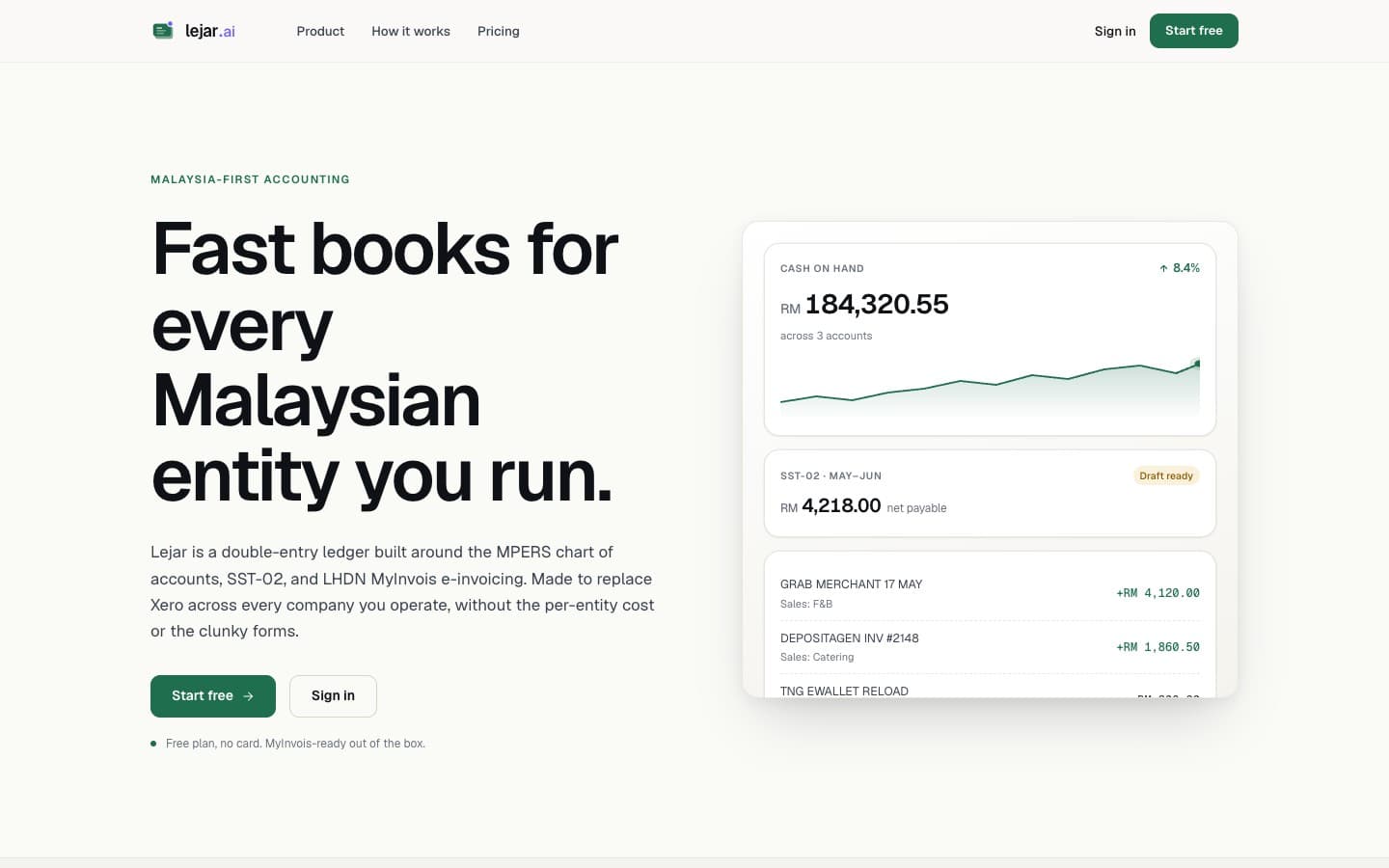
A Malaysia-first accounting platform built around the MPERS chart of accounts, SST-02, and LHDN MyInvois e-invoicing. Upload a receipt or a bank statement and Lejar drafts the double-entry bookkeeping for you to review, approve, and post.
Results
Measurable outcomes, not adjectives.
- Live, free plan at lejar.ai
- Live
- MPERS, SST-02, MyInvois
- Malaysia-first
- Receipt or statement to draft
- AI bookkeeping
- Replace Xero per entity
- Multi-entity
The story
The brief
Build the accounting tool a Malaysian small-business owner would actually keep open. The incumbents are powerful but heavy, assume a bookkeeper sits between the owner and the ledger, and treat Malaysia as an afterthought on a chart of accounts designed elsewhere. Lejar had to be a genuine double-entry system that a non-accountant can run, with the AI absorbing the tedious data entry instead of just bolting a chatbot onto a legacy UI.
What we built
A complete books workflow on a Malaysian chart of accounts: invoices, bills, quotes, single-entry expenses, fixed assets, and a posting journal behind every document. Reports include a general ledger and a cashbook that reconcile to the underlying entries. Supabase backs the data layer with row-level security and per-organisation isolation; Next.js App Router server actions drive every mutation. The whole thing reads in plain language so the owner sees "money in / money out", not debits and credits, while the ledger stays correct underneath.
Why AI-native, not AI-bolted-on
The AI is the data-entry layer, not a novelty. Drop a receipt, an invoice PDF, or a bank statement into the inbox and Lejar drafts the matching journal entry, invoice, or bill, suggests the account to code it to, and routes unmatched payments toward a journal entry instead of a dead end. The owner reviews and posts. Because suggestions are drafts the human approves, the ledger never fills itself with confident mistakes, and the system gets the speed of automation without surrendering the accuracy a real set of books demands.
Built for Malaysian accounting
Lejar is Malaysia-first by design rather than a US/UK product with a local skin: the ledger is built around the MPERS chart of accounts, SST-02 tax handling, and LHDN MyInvois e-invoicing out of the box. It is meant to run every entity an owner operates without charging per company, so a group of small businesses isn't paying a separate Xero seat for each. Migrating an existing business is an opening-balance import from Xero via a dedicated flow, not a manual re-key of history. Account management is guarded the way a real ledger must be: codes already referenced by entries can't be silently changed, deletions are blocked when entries depend on them, and new accounts slot into a sensibly spaced numbering scheme.
What's next
Payee memory so recurring suppliers code themselves after the first time, bank-statement intake polish, and a WhatsApp capture flow so an owner can forward a receipt photo and have it drafted into the books. Monetisation (plans and AI-usage limits) is wired but deliberately switched off during beta while the feature set and UX are taken to a polished, daily-driver standard.
Built with
- Next.js 15
- React 19
- Tailwind v4
- Supabase
- Anthropic Claude
- Vercel